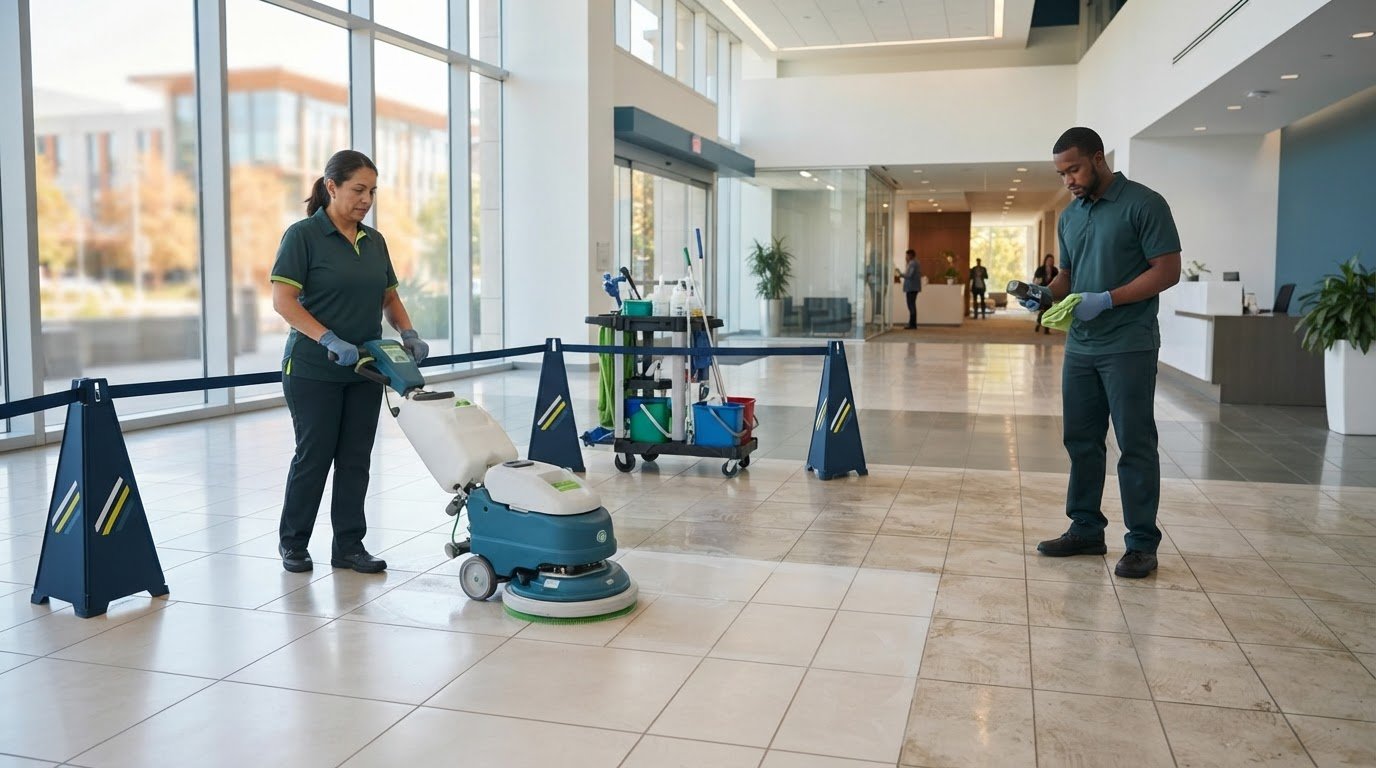


A fixed floor-care calendar can create more problems than it solves. Commercial hard floor maintenance programs work best when they reflect each surface, traffic pattern, and facility schedule rather than applying the same routine everywhere. A busy entrance, a quiet office corridor, and a tiled washroom each place different demands on floors.
When maintenance is mostly reactive, it can be difficult to plan staff time, coordinate work around building use, and recognize when routine cleaning is no longer enough. A practical program makes those decisions easier to manage. It links day-to-day tasks with condition reviews and periodic restoration, helping teams care for floors consistently without assuming every area needs the same treatment.
This guide explains how to build a program around flooring type and traffic, set realistic tasks for routine and periodic care, and recognize when restoration and protection may be appropriate. It also covers how to document responsibilities and changes so the plan is easier to communicate, review, and adjust as facility needs evolve.
Key Takeaways
- Commercial hard floor maintenance programs are most useful when each floor area has clear, recurring tasks matched to its surface and use.
- Separate routine care from periodic restoration, and use observed floor condition to decide when a closer review is warranted.
- Assess floor areas, assign responsibilities, coordinate access, and document changes so the plan stays practical.
- Cleanit Maintenance Systems serves commercial facilities in Greater Sacramento with floor restoration and protection, alongside commercial janitorial services.
What Commercial Hard Floor Maintenance Programs Actually Do
A commercial hard floor maintenance program is a planned cycle of care that matches tasks and timing to a floor’s material, condition, use, and operating environment. It gives facility teams a shared approach to maintaining different surfaces instead of treating every floor as if it needs the same work.
An isolated cleaning task addresses an immediate need, such as tracked-in soil or a visible spill. Ongoing maintenance is broader: it sets recurring expectations, tracks how surfaces are holding up, and helps teams anticipate when additional care may be appropriate. Restorative work addresses deterioration that routine tasks alone may not resolve. Replacement is a separate facilities decision, not simply another cleaning step.
In practice, a program connects these levels of care. It clarifies what should happen regularly, what changes in floor condition should prompt a review, and where restoration may fit into a longer-term plan. The goal is not to promise that floors will remain unchanged. It is to make their care more deliberate, support a consistent appearance, and keep surfaces suitable for their intended use.
Why floor material and use shape the program
Hard floors differ in material, finish, age, and current condition. Those differences affect which methods and products are appropriate, so a task that suits one surface should not automatically be applied to another. Use manufacturer guidance to inform product and method choices. For a general overview of how approaches vary across surfaces, Floor cleaning describes common floor types and cleaning methods.
Use matters just as much. A busy entrance may collect soil more quickly than a lower-traffic office, while a corridor used throughout the day may have different demands from a room used occasionally. These differences do not establish a universal schedule. They help teams identify where conditions may call for closer attention and where a lighter routine may be appropriate.
What a program aims to make more predictable
Planned tasks give teams a clearer basis for organizing routine care and anticipating periodic needs. For example, staff can distinguish a recurring cleaning task from a condition review, then record when a change in appearance or finish calls for reassessment. That makes it easier to communicate needs, coordinate work with facility use, and adjust the plan as traffic or floor condition changes.
Consistency also supports an orderly, professional environment. Floors are among the surfaces people encounter as they move through a facility, and visible soil or uneven-looking wear can affect the overall impression of a space. A program makes floor condition part of routine facility review instead of something noticed only when it becomes difficult to ignore.
Results depend on site conditions and care that is correctly matched to the surface. Commercial hard floor maintenance programs provide structure, not a guarantee of a particular appearance or lifespan. Their value is in setting clear expectations, guiding review, and helping teams make informed decisions about ongoing care and restoration.
Build the Program Around Surfaces, Traffic, and Daily Operations
A useful plan begins with a clear picture of the floors already in place. Before setting tasks or timing, inventory each hard-floor area and record its material where known, approximate size, finish condition, and typical use. The goal is not to create a complicated survey. It is to gather enough detail to distinguish one zone’s needs from another’s and avoid applying a single routine across surfaces that behave differently.
Map floor types and traffic zones before setting tasks
Walk the facility and group areas by both surface and use. An entrance, a main corridor, a shared break area, and a low-traffic office may need different attention, even if some floors appear similar. Note where people, carts, or deliveries regularly pass. Mark visible changes such as dullness, scratches, or uneven-looking wear for review, without assuming what caused them. The appropriate response depends on the surface and its condition.
A compact assessment checklist can make the walk-through practical:
- Location and extent: Identify each hard-floor area and estimate its size.
- Surface details: Record material and finish information when available, along with visible condition.
- Use pattern: Note entrances, corridors, shared spaces, and areas with distinct activity.
- Operating constraints: Capture access windows, occupant needs, available staff, and equipment considerations.
- Care references: Keep relevant product labels and flooring manufacturer instructions with the plan.
This record gives teams a basis for grouping zones. An entrance and an adjacent corridor may both see frequent use, for example, but the entrance may collect soil differently. A quiet office can be grouped with other lower-traffic spaces if its flooring and operating needs are comparable. Let observed conditions guide the grouping, then revise it when use or floor condition changes.
Match care tasks to facility operations
Once zones are mapped, separate recurring soil removal from periodic finish care or restoration needs. The plan should make clear which tasks are routine, which depend on a change in condition, and who is responsible for reporting that change. Commercial hard floor maintenance programs are easier to manage when tasks match both the floor and the site’s actual capacity, rather than a generic calendar.
Timing also has to work for the people who use the space. Consider when an area can be accessed, how work may affect staff, tenants, or visitors, and whether the necessary equipment and personnel are available. Even an appropriate task needs a workable window and clear coordination. Follow product labels and applicable manufacturer instructions when selecting methods and products. Do not assume a familiar approach suits every floor.
Documenting these decisions turns observations into a plan that can be reviewed, not just filed away. For facility teams considering how floor condition fits into broader slip-and-fall prevention, the National Floor Safety Institute provides additional safety resources. Keep decisions grounded in your site’s surfaces, use, and operating requirements as you refine the care plan.
Compare Reactive Cleaning, Routine Care, and Periodic Restoration
These three approaches serve different purposes. Reactive cleaning responds to an immediate issue, such as a spill or a patch of tracked-in soil. Routine care addresses ordinary, recurring soil before it builds up. Periodic restoration responds to a floor’s condition when regular cleaning is no longer enough to meet the maintenance goal. A sound plan distinguishes among them instead of treating them as interchangeable.
The comparison below can help facility teams decide what belongs in a recurring task list and what should prompt a closer assessment:
- Reactive response: Use it to address an immediate, localized need. It can resolve a current cleaning concern, but relying on it alone makes labor and access harder to plan because work follows problems as they appear.
- Routine care: Use recurring tasks suited to the surface and its use to manage ordinary soil. Routine work provides continuity, but it may not correct visible wear or a finish condition that needs a different level of attention.
- Periodic restoration: Consider it when observations indicate routine care may no longer be sufficient. Restoration and protection address a different need from everyday cleaning. An assessment should guide whether work is appropriate and what it should involve.
Routine maintenance manages ongoing soil; restoration addresses condition concerns that routine tasks alone may not resolve. Keeping that distinction clear helps teams avoid treating every change in appearance as a restoration requirement or expecting regular cleaning to resolve a deeper condition issue.
When a recurring routine is more useful than waiting for visible wear
Consistent care gives teams a planned way to handle ordinary soil before it accumulates and becomes a more noticeable facility concern. When a plan starts only after appearance has declined, staff may have to respond under pressure, coordinate access late, or shift attention away from other scheduled work. A recurring routine makes expected work easier to organize while still allowing adjustments when site conditions change.
Set frequency according to actual traffic, observed conditions, flooring material, and applicable manufacturer guidance, not a universal calendar. A high-use area may need a different level of attention from a quieter one, but establish that difference through site review rather than assumption. Keep task instructions practical and consistent with product labels.
How to recognize when restorative attention deserves review
Persistent dullness, uneven appearance, or visible wear can be useful prompts to reassess a zone. They do not, by themselves, identify the cause or prove that a specific treatment is needed. Record what has changed, where it appears, and whether it continues after routine care. Those notes give the next maintenance decision a clearer foundation.
Commercial hard floor maintenance programs should leave room for condition-led review. The ISSA - The Worldwide Cleaning Industry Association offers cleaning-industry resources for continued learning, while flooring manufacturer instructions should guide surface-specific methods. Separating regular care from restoration and protection helps teams plan each appropriately without assuming one replaces the other.
Turn the Assessment Into a Workable Sacramento Facility Plan
An assessment becomes useful when it leads to clear responsibilities and repeatable decisions. For commercial facilities in Greater Sacramento, conditions can vary from one building to another and between zones in the same building. Use the steps below to turn observations into a working plan, then adjust it as occupancy, floor condition, or daily operations change. The goal is a practical framework, not one schedule for every site.
- Assess the surfaces. Gather the floor inventory, available manufacturer instructions, and notes on visible condition. Record areas that need closer review instead of assuming a cause or treatment.
- Zone the facility. Group spaces by floor type, use, and operating needs. An entrance, shared corridor, and lower-traffic office may need distinct task instructions even when they are in the same building.
- Assign tasks and ownership. Identify which recurring tasks are handled by in-house teams and where specialized support, such as floor restoration and protection, may be appropriate. Name a responsible role for reporting changes or unresolved concerns.
- Schedule access. Coordinate planned work with occupancy, deliveries, and the facility’s operating rhythm. Include access needs and equipment considerations so staff can prepare the area and communicate timing.
- Document the work. Keep concise records of task completion, observed condition, recurring problem areas, and follow-up actions. A simple log by zone can help teams recognize whether an issue is isolated or recurring.
- Review and revise. Revisit the plan when traffic, occupancy, or floor condition changes. Use recorded observations to decide whether task instructions, responsibilities, or timing need adjustment.
Set responsibilities, access windows, and records
A clear plan explains who handles routine work and how a concern moves from observation to follow-up. For example, an in-house team might record recurring soil in a high-use zone, while a designated facilities contact reviews whether the current task is suitable or whether restoration deserves assessment. Set access expectations around the building’s actual use, including staff presence and delivery activity. Keep records brief enough to maintain: date, zone, work completed, condition observed, and next action.
Review the plan and adjust when conditions change
Review patterns, not just individual entries. If the same area repeatedly needs attention, examine whether its use has changed or whether its assigned care still fits. A new tenant, altered traffic flow, or visible change in condition can all be reasons to reassess. Facilities comparing their approach with wider facility cleaning and maintenance guidance or learning about commercial floor maintenance in Sacramento should still base task decisions on their own surfaces and operations.
Cleanit Maintenance Systems supports commercial facilities in Greater Sacramento with floor restoration and protection. To discuss how this work can fit into a practical facility plan, contact Cleanit about commercial floor care.
How Cleanit Supports Commercial Hard Floor Care in Greater Sacramento
A well-planned floor-care program reflects the building it serves. After assessing surfaces, use, and maintenance needs, facility teams can use that information to plan ongoing janitorial care and more focused floor work. Cleanit Maintenance Systems serves commercial environments in Greater Sacramento with floor restoration and protection, alongside commercial janitorial services.
Cleanit is a privately owned local business that has operated for over 30 years. Its work includes commercial janitorial services; that experience is not limited to floor care. For facility managers, Cleanit provides a local point of contact for discussing how floor restoration and protection may fit alongside the broader needs of a commercial environment.
Connect ongoing facility care with specialized floor support
Routine janitorial care and floor restoration or protection address different needs, but they can complement each other. Recurring care handles regular cleaning responsibilities, while restoration and protection may be appropriate when an assessment indicates the floor needs more than routine attention. Keeping these roles distinct helps facilities plan work thoughtfully and avoid treating a specialized service as a substitute for ongoing care.
Commercial hard floor maintenance programs should stay grounded in each site’s assessment. Floor material, finish, visible condition, traffic, and operating needs all inform the discussion. Manufacturer guidance and product instructions should also shape decisions about suitable care. Cleanit’s commercial service focus gives Greater Sacramento facilities a local resource for discussing restoration and protection within that broader planning context, without relying on a one-size-fits-all schedule or assumed treatment.
Facilities reviewing their broader cleaning needs may also find it useful to consider how commercial floor cleaning services fit into wider facility responsibilities. The right support depends on what the building needs, how its areas are used, and what the assessment shows. Clear observations help keep planning practical.
Make the next conversation straightforward
A useful starting point is a brief outline of your facility type, the hard-floor areas you manage, how those areas are used, and the main concerns you have observed. Include relevant manufacturer instructions and explain how floor work must fit around building operations. You do not need to arrive with every decision already made. A clear picture of the site gives the discussion a sound foundation.
Cleanit supports commercial facilities in Greater Sacramento with commercial janitorial services, floor restoration, and protection. If you are considering restoration or protection as part of your facility’s care plan, contact Cleanit to discuss your floor-care needs.
Set Your Floor-Care Plan in Motion
A maintenance plan becomes useful when someone is responsible for keeping it current. Choose a person to receive condition updates, note unresolved concerns, and bring those observations into the next review. That small step helps turn commercial hard floor maintenance programs into a working part of facility operations, rather than a document set aside after it is written.
Then choose a practical starting point: agree on the first area to review, record its current condition, and decide when the team will revisit its care needs. Use what you learn to refine the plan gradually, keeping each decision grounded in the floor itself and the way your facility uses the space. A steady, considered approach can make future maintenance decisions clearer.
For help planning floor restoration or protection at your commercial facility in Greater Sacramento, contact Cleanit to discuss your floor-care needs.
Frequently Asked Questions
Can the same cleaning products be used on every commercial hard floor?
No. A product suited to one floor material or finish may be unsuitable for another. Identify the surface before choosing a cleaner, then follow its label and relevant flooring manufacturer guidance. If a building has different floor materials in its lobby and offices, for example, record care instructions for each area separately. That reference helps staff avoid carrying one product choice from zone to zone by habit.
Can commercial floors be maintained without stripping and waxing?
Yes, some commercial floor-care needs can be met with recurring cleaning or other suitable maintenance, but the right approach depends on the floor material, finish, and condition. Stripping and waxing should not be treated as the default for every hard floor. Before planning this work, review the surface and its manufacturer guidance. This helps distinguish a floor that needs routine attention from one whose finish may warrant assessment.
How do entrance mats affect a hard-floor maintenance plan?
Entrance mats can help capture soil before it spreads farther into the building, so include them in the entrance-area plan. Their placement should suit how people enter and move through the space, and their condition needs regular attention. Note whether a mat shifts, appears worn, or no longer covers the area where people walk. These observations can prompt a review of the entry setup and nearby floor care.
What should a facility manager track to evaluate a floor maintenance program?
Track completed tasks, the floor areas involved, recurring observations, access or scheduling problems, and follow-up actions. Add a brief note when a task could not be completed as planned, such as when an area was occupied, so the record shows operational constraints as well as cleaning activity. Reviewing these notes over time can help managers see whether the plan still fits the facility’s use and where further assessment may be useful.
What should staff do when a spill occurs on a commercial hard floor?
Follow the facility’s established spill-response procedures and use the protective measures specified for the situation. Before applying a cleaner, consult the product label and relevant surface instructions, since a method suitable for one floor may not suit another. Once the immediate response is complete, record unusual or repeated spills and their locations. A recurring issue near a workstation or entry may call for a review of how that area is managed.
Does Sacramento’s seasonal weather affect commercial hard-floor maintenance?
It can affect the soil tracked into a building, particularly around entrances. Rather than changing the whole schedule based on the season alone, observe conditions at entry points. Note soil patterns, mat placement, and whether mats remain in usable condition. A Sacramento facility can use these observations to decide whether specific entrance zones need adjusted attention. Keep any change consistent with the floor material’s care instructions and the facility’s operations.